Chris Kwan
Operating manual
Full-stack developer who builds AI-powered products and runs them in production.
I design, ship and operate complete systems: crawlers, data pipelines, LLM integrations, APIs and web front ends. I'm looking for a developer role where I can do that on a team, whether that's full-stack, frontend, backend or AI application work.
Open to developer roles: Full-Stack Developer, Frontend Developer, Backend Developer, AI Application Developer, Software Developer.
Currently System Builder at Memory Express; previously IT Administrator at Miss Kwan's House Limited.
What I've built
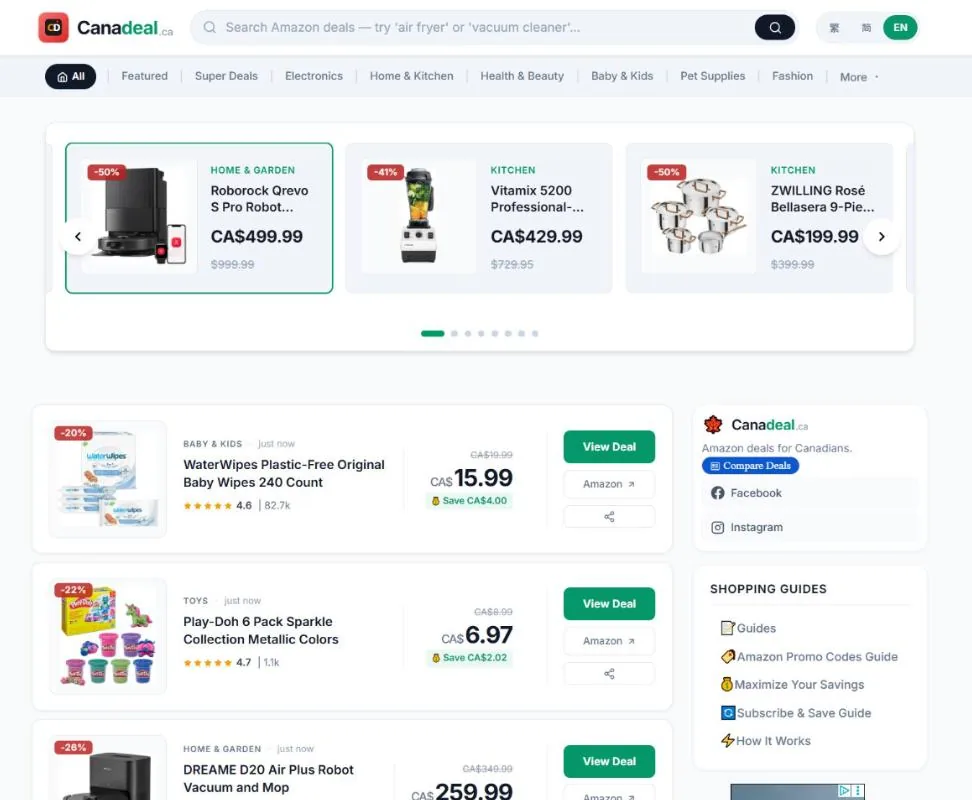
An AI-powered deal platform that finds, verifies, translates and publishes deals for Canada's Chinese-speaking community, with no one in the loop.
- products processed
- 20,000+ products processed
- new deals, fully automated
- ~110 / day new deals, fully automated
Daily price history for about 12,500 T&T Supermarket products across 2 stores and 3 languages, so you can see whether a price is actually good.
- products tracked daily
- ~12,500 products tracked daily
- fewer requests with a two-phase crawl
- ~95% fewer requests with a two-phase crawl
A link shortener with an affiliate engine: custom aliases, QR codes, weighted A/B redirects and click analytics behind plan-based access control.
- weighted redirect tests
- A/B weighted redirect tests
- plan tiers enforced in the API
- 3 plan tiers enforced in the API
A live, filterable feed of discounted Flashfood groceries across cities, stores and categories, in five languages.
- real-time feed, no polling
- Live real-time feed, no polling
- interface languages
- 5 interface languages
An AI resume builder that matches a structured career profile to any job description and exports a tailored resume, without inventing facts.
- export formats (PDF, DOCX, MD, TXT)
- 4 export formats (PDF, DOCX, MD, TXT)
- job-description matching
- AI job-description matching
Where I've worked
System Builder, Memory Express
Jan 2026 – Present
Developed self-initiated Python/Playwright and PowerShell automation tools to streamline internal production workflows, reduce repetitive data entry and minimize input errors.
IT Administrator, Miss Kwan's House Limited
2018 – 2022
Built a JavaScript + Google Sheets ERP system handling inventory, customer management, invoicing, delivery notes, quotations, and automated PDF generation.
IT Administrator, Jet System Pacific
2014 – 2018
Administered 43 desktops across head office and branch, managing Windows Server, Active Directory, user accounts, Windows deployment, network configuration, routers and DNS.
What I work with
I don't sell services. But these are the kinds of systems I end up building — when I see the same work done twice, I build something so nobody has to do it a third time. If something here looks like a problem you have, my email is at the bottom of the page.
- Automation, removing repetitive work
- Python, Playwright, and PowerShell tools that do the boring parts: data entry, extraction, reconciliation. Built at Memory Express, where I automated parts of my own job because doing the same clicks every day felt like a bug.
- System integrations, making different systems agree
- REST APIs, data cleaning, normalisation, and dedup across multiple sources into MongoDB, run by distributed workers with locking, monitoring, and logging. That's how Canadeal pulls deals from many sources into one place without duplicates or made-up prices.
- Document processing, reading the unreadable
- Vision models and OCR that read real-world documents — supermarket flyers, in Canadeal's case — and turn them into structured data. Unreadable means null and flagged for a human, never guessed.
- Agentic AI, loops that do the work, with a human watching
- Agent loops that implement, test, and report back in small steps. I run them daily: Qwen Code loops on my own projects, and a care-management system built the same way.
- Working with LLMs, applications, not demos
- Content generation and AI features inside real products: Canadeal's AI-written deal content, and an AI resume builder (resume.canadeal.ca). I build applications with LLMs; I don't train models.
- Web, the stack I actually ship in
- Next.js, React, TypeScript, FastAPI, MongoDB, Redis, Meilisearch, Docker.
Also: an internal ERP-style system (Google Sheets + Apps Script) that ran a small company's daily operations — orders, records, and the unglamorous work in between.
Questions about any of this? chriskwanmy@gmail.com
Writing on AI
Eleven Days Without Jensen Huang
NVIDIA lost its CEO, then got him back with help from the White House. It looks like a comeback story. I think it was a stress test, and the result is not comfortable.
Give the Agent Its Own Desk
How I run AI agents day to day: four machines I already owned, each with one job, so models think in one place, agents work in another, and I keep my own computer.
Qwen4-Max, Three Days In: Architecture, Cost, and the Fine Print
Notes from reading the launch post, three independent hands-on tests and the pricing pages, and what I plan to test next.
The Only Real Test of AI Skill Is What You've Actually Shipped
Everyone wants to know who really knows how to use AI. The honest answer isn't about which tools they know — it's about the scale and completeness of what they've built.
How I work
I think in systems by default.
I'm Chris. A systems thinker who arrived the long way around — through boredom, repetition, and a stubborn refusal to do the same thing twice. This isn't a portfolio in the usual sense. It's closer to documentation: an attempt to describe my own operating system as honestly as I can.
Problem-driven, not task-driven.
A vague assignment puts me to sleep. A real problem with real consequences wakes something up. When something actually matters, I learn fast and go deep — not out of discipline, but because I can't help it.
Why doesn't a system exist for this yet?
When I see repetitive work, I don't think “work harder.” I think “why hasn't this been turned into a system?” I'd rather spend a day building something that removes a task forever than ten minutes a day doing it by hand. Effort that has to be repeated feels like a bug.
Useful, not impressive.
I want to build things people actually use — systems that keep producing value when I'm not in the room. Money matters to me, but mostly as evidence: proof that something I built reached the real world. I'd take useful over impressive every time.
I'm good at solving. I'm learning to finish.
I'm good at the part where a hard problem gets solved. I'm still learning the part that comes after — the polishing, the finishing, the making-it-real. This whole site is me being honest about both.